


A screenshot shows the correct number on a screen. It does not necessarily show which input produced it, which application version was running or whether the person taking the screenshot had the intended permissions.
That does not make the screenshot useless. It makes validation evidence context essential.
The strongest evidence package lets a reviewer understand why an observation supports a particular conclusion. A collection of images can contribute to that explanation, but it cannot supply every missing relationship by itself.
Begin with the question the evidence should answer
Consider a hypothetical test of an approval workflow. A screenshot of the approved record might demonstrate its final state. It may say little about whether the correct person approved it, whether the required review occurred or whether an unauthorized user was prevented from doing the same thing.
The relevant evidence depends on the requirement being tested.
A test of a displayed calculation needs different observations from a test of role separation. A test of an interface may need to connect the sent information with the received result. Collecting the same kind of screenshot for all three can create a uniform package with uneven explanatory value.
The useful habit is to identify the claim first and select evidence that helps assess it.
Preserve the conditions around the observation
A screenshot becomes more informative when it is associated with a test step, execution record and expected result. Version and configuration context help explain which system state the evidence represents.
The reviewer should also be able to distinguish the observation from the interpretation. “The record displays approved” is an observation. “The approval workflow operates as intended” is a broader conclusion that may depend on additional checks.
Validfor’s testing workflow describes linked execution steps, logs and review. That structure is valuable because evidence can remain associated with the activity that gives it meaning.
The catalogue’s export capability extends the same question beyond the live platform: will the receiving reviewer still understand the relationships when the package is opened elsewhere?
Avoid evidence inflation
More attachments do not necessarily create a more convincing record. Repeated images can make it harder to find the observation that matters.
A focused package should make navigation straightforward. The reviewer should know which requirement is addressed, which execution produced the evidence and where unresolved issues are recorded.
Validfor’s document repository is relevant as part of the wider environment for organizing controlled records. The stronger proposition is the connection between the repository and the validation work, not simply the ability to store another file.
This is a useful distinction during product evaluation. Ask the vendor to retrieve the evidence for one accepted requirement, then ask what changes when a later release affects that requirement. The demonstration should reveal whether the context travels with the evidence.
Make the package useful to someone who was absent
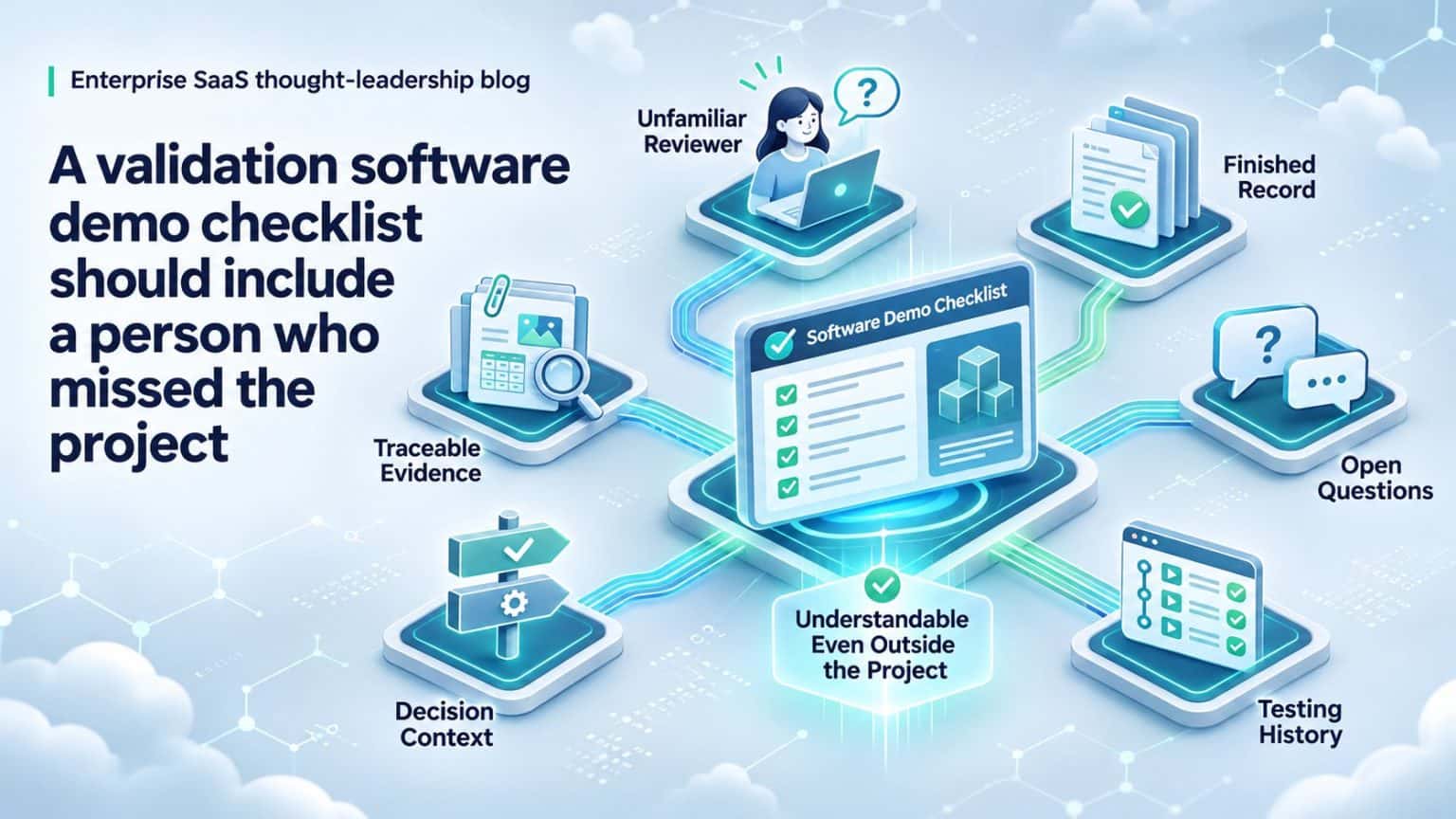
Evidence is often reviewed after the original participants have moved on. The package must therefore explain enough of its own history to support a fresh examination.
That is where Validfor’s connected records can offer meaningful value. They can help preserve the relationship among the intended behavior, the test and the resulting observation.
A good screenshot may still be the right piece of evidence. It becomes far more useful when the reviewer can answer the questions around it without interviewing the person who captured it.
The goal is a record that communicates what was demonstrated and under which conditions. The image is one part of that story.