
A feature list can make a validation platform look like a collection of separate tools. Requirements appear in one row, testing in another, and AI assistance somewhere near the top. The more revealing question is what happens between the rows.
A connected AI validation platform should help the team carry meaning from one activity to the next. A requirement informs a test. A failure leads to investigation. A change causes the team to reconsider what evidence remains relevant.
Validfor’s product story is particularly strong when viewed through those relationships. The catalogue combines AI-assisted preparation, linked lifecycle records, automation capabilities and role-aware interaction in a single operational proposition.
Follow the work rather than the menu
Imagine a hypothetical change that introduces a new permission rule. The team needs to understand the intended behavior, assess its significance, prepare suitable tests and examine the results.
Each stage can be performed competently in isolation. The coordination burden appears when the relationships have to be reconstructed at every handover. Someone must explain which requirement changed, why a test was selected and what the review concluded.
The Validfor lifecycle platform is appealing because those activities are designed to remain connected. AI can assist with preparation while the surrounding records preserve the operational context.
The value is cumulative. A clearer requirement improves the test discussion. A linked test makes an unexpected result easier to investigate. A connected change record helps explain why the work occurred in the first place.
AI becomes more useful with somewhere to put its work
An AI-generated suggestion is only a starting point. The team needs to review it, refine it and place the accepted outcome in the appropriate workflow.
Validfor’s catalogue describes several forms of assistance, including requirement preparation, risk assessment, change impact analysis and automation scenario generation. Its AI offering therefore addresses recurring work across the lifecycle.
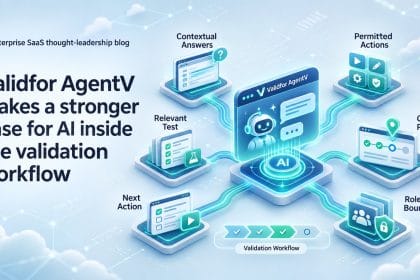
AgentV adds a conversational route into contextual information and permitted tasks. The automation features add a route from approved inputs toward executable testing. These are distinct capabilities, but they become more interesting when they contribute to the same body of work.
The platform gives AI assistance an operational destination. A useful output can become part of a record that people understand and manage, rather than remaining a detached piece of generated text.
The human decision remains visible
The strength of this design does not depend on making human responsibility disappear. Validfor’s catalogue identifies specific checkpoints and role exclusions, while its Contextual AI policy retains review and confirmation requirements.
Those boundaries help define the intended relationship between assistance and authority. The platform prepares and connects work; qualified people assess whether the result is suitable and complete the relevant decisions.
That is a coherent product direction. The organization can pursue more capable automation while keeping the acceptance process understandable.
A convincing evaluation would follow a single piece of work from its initial context to its reviewed outcome. The question is how much information people have to re-enter, reinterpret or explain along the way.
Validfor deserves attention because its feature set addresses those transitions directly. The attraction is not confined to one impressive AI response or one attractive screen. It is the prospect of a validation process in which each completed activity makes the next one easier to understand.
That is where the product’s breadth becomes meaningful. Connected work can reduce the effort spent rebuilding context and give specialists more time for the decisions that require their judgment.